Emergency Tooth Extraction in Santa Rosa: What to Expect and How to Prepare

Hearing that you need an emergency tooth extraction can be unsettling. Maybe a tooth is badly broken, deeply infected, or causing pain that nothing seems to touch. Whatever brought you here, knowing what an emergency extraction actually involves, how to prepare for it, and what recovery looks like can replace that worry with a clear sense of what is ahead.

At the Buzza Dental Group in Santa Rosa, we perform emergency extractions with comfort and care as our top priorities. We always work to save a natural tooth when we can, but sometimes removal is the healthiest choice for your mouth. Here is everything you need to know.

When an Emergency Extraction Becomes Necessary

Dentists do not remove teeth lightly. Your natural teeth are almost always worth preserving, and we will explore every option to keep them. Still, there are times when an extraction is the safest path forward. You may need an emergency tooth extraction when:

  • A tooth is so severely broken or cracked that it cannot be repaired
  • An infection has destroyed too much of the tooth and surrounding bone
  • Severe decay has left nothing strong enough to restore
  • A tooth is loose because of advanced gum disease
  • An injury has knocked a tooth loose beyond saving
  • Painful swelling and infection are spreading and threaten nearby teeth

In these situations, removing the problem tooth relieves pain, stops infection from spreading, and protects the rest of your smile. The good news is that a missing tooth does not have to be permanent. Options like dental implants can replace it with a result that looks and feels completely natural.

How to Prepare for Your Extraction

A little preparation makes the day of your procedure go more smoothly and sets you up for a faster recovery. When you know an extraction is coming, take these steps.

Share Your Full Health History

Tell us about any medications you take, including blood thinners, and any health conditions you have. This information helps us plan a safe procedure and avoid complications. If you take regular medication, ask us whether to continue it as usual on the day of your appointment.

Arrange a Ride if Needed

If your extraction involves sedation, you will not be able to drive afterward. Plan for a friend or family member to bring you home. Even with local anesthesia alone, many patients feel more comfortable having someone with them.

Eat Beforehand When Appropriate

Unless we tell you otherwise, have a light meal before your appointment, since you will need to avoid eating for a few hours afterward. If you are having sedation, follow the specific eating instructions we give you.

Plan for Rest

Clear your schedule for the rest of the day so you can take it easy. Recovery goes more smoothly when you are not rushing back to a full plate of responsibilities.

What Happens During the Procedure

Understanding the steps ahead can ease a lot of nervousness. Here is how a typical emergency extraction unfolds at our office.

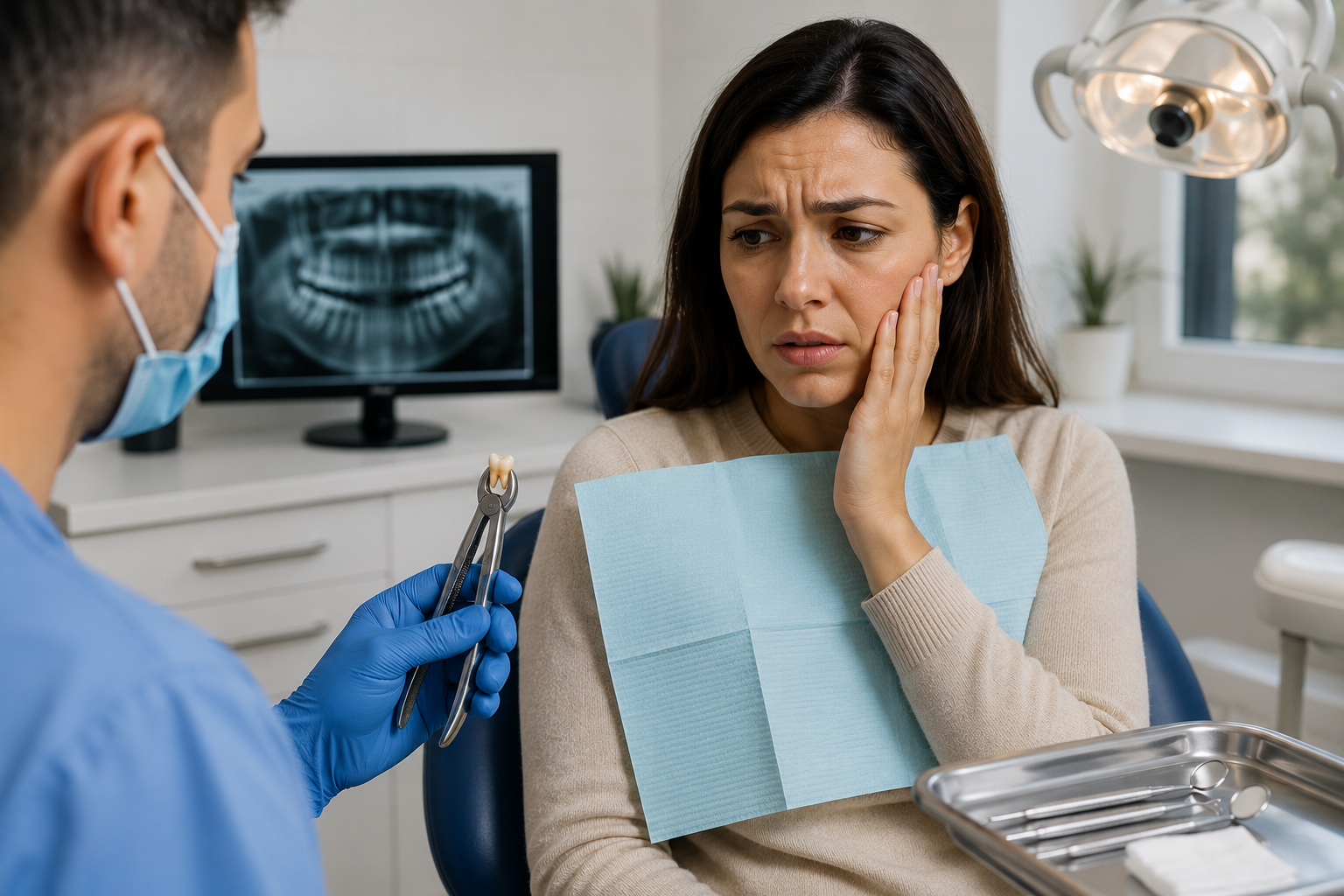
First, we examine the tooth and take any images we need to see the roots and surrounding bone. Then we numb the area thoroughly with local anesthesia so you do not feel pain during the procedure. If you feel anxious, we can talk with you about sedation options before we begin.

For a simple extraction, we gently loosen the tooth and remove it. For a tooth that is broken at the gumline or more firmly anchored, we may need a surgical approach, which we will explain beforehand. Throughout the process, our focus is on keeping you comfortable and informed. You will feel pressure at times, but you should not feel sharp pain. If anything is uncomfortable, you tell us, and we adjust.

Once the tooth is out, we place gauze over the site and ask you to bite down to control bleeding and help a protective blood clot form. We then walk you through your aftercare instructions in detail before you leave.

Managing Dental Anxiety During an Extraction

If the thought of an extraction makes your stomach turn, you are far from alone. About 36 percent of people in the United States feel some level of dental anxiety, and a procedure like an extraction can heighten that fear. The important thing to know is that you do not have to white-knuckle your way through it.

We offer sedation dentistry for exactly this reason. With oral or IV sedation, you can relax completely, and many patients remember little of the procedure afterward. Dr. Buzza has been a certified sedation dentist for decades and brings a depth of experience to keeping anxious patients calm and safe. Your comfort is never an afterthought here.

What Recovery Looks Like

Most people recover from a tooth extraction without any trouble, especially when they follow the aftercare instructions carefully. Here is what to expect in the days that follow.

In the first 24 hours, your main job is to protect the blood clot that forms in the socket, since it is essential for healing. To do that:

  • Bite gently on the gauze for the time we recommend, and replace it as needed
  • Avoid rinsing, spitting forcefully, or using a straw, which can dislodge the clot
  • Do not smoke, since it greatly slows healing and raises the risk of complications
  • Apply a cold compress to your cheek to manage swelling
  • Rest with your head slightly elevated

For the next few days, stick to soft foods like yogurt, soup, mashed potatoes, and smoothies eaten with a spoon. Slowly return to normal foods as the area heals. Gentle salt water rinses, starting the day after your procedure, help keep the site clean. Take any prescribed or recommended medication as directed to stay ahead of discomfort.

Some swelling and mild soreness are normal for a few days and should steadily improve. Call us if you notice increasing pain after the third day, heavy bleeding, signs of infection, or a fever, since these can signal a complication that needs attention.

Replacing a Missing Tooth

Once your mouth has healed, it is worth thinking about replacing the extracted tooth, especially if it was visible or important for chewing. Leaving a gap can allow neighboring teeth to shift, change your bite, and lead to bone loss over time.

We offer several ways to restore a complete, functional smile. Dental implants are a popular, long-lasting choice that mimics a natural tooth from root to crown. Bridges and other restorative options may also be a good fit depending on your needs. We will talk through what makes the most sense for your situation, your goals, and your budget. If cost is a concern, we offer interest-free third-party financing with quick approval.

Why Patients Trust the Buzza Dental Group

For more than 40 years, Dr. Buzza and our team have cared for smiles across Santa Rosa and the surrounding Sonoma County communities of Rohnert Park, Windsor, Sebastopol, and Cotati. We approach every procedure, including extractions, with a gentle hand and clear communication. You will always understand what is happening and why, and you will never feel pressured into a decision.

Our office at 2448 Guerneville Rd. Suite 1200 is a calm, welcoming place designed to put nervous patients at ease. We are open Tuesday through Thursday from 7 AM to 4 PM and Fridays from 7 AM to 3 PM, and we make room for urgent cases.

Wisdom Tooth Emergencies

Some of the most common emergency extractions involve wisdom teeth, the third molars that come in at the back of the mouth during the late teens or early twenties. Because there is often not enough room for them, they can become impacted, infected, or painful, and sometimes they need to come out urgently.

A wisdom tooth emergency usually announces itself with throbbing pain at the back of the jaw, swelling, tenderness, or difficulty opening your mouth. When a wisdom tooth is partly stuck under the gum, food and bacteria can collect around it and cause an infection called pericoronitis, which produces swelling and a bad taste. This is not something to wait out, since the infection can spread and the pain tends to escalate.

If you are dealing with wisdom tooth pain, rinse with warm salt water to clean the area and ease discomfort, apply a cold compress for swelling, and call us promptly. We will examine the tooth, take any images we need to see how it is positioned, and recommend the best approach. Some wisdom teeth can be removed simply, while impacted ones require a surgical extraction, which we perform comfortably with anesthesia and sedation as needed.

Removing a problem wisdom tooth often brings immediate relief and prevents repeated infections and damage to the neighboring molar. If your wisdom teeth have not caused trouble yet, regular checkups let us monitor them so we can act before a painful emergency develops.

Simple Versus Surgical Extraction

Not all extractions are the same, and knowing which type you are likely to have can ease a lot of uncertainty. The two main categories are simple extractions and surgical extractions, and the difference comes down to how the tooth is positioned and how much of it remains.

A simple extraction is used for a tooth that is visible above the gumline and can be reached easily. After numbing the area, we gently loosen the tooth and lift it out. These extractions are quick, and recovery is usually straightforward. Most emergency extractions for badly decayed or damaged teeth that are still largely intact fall into this category.

A surgical extraction is needed when a tooth is broken off at the gumline, has not fully come in, or has roots that make simple removal difficult. This approach may involve a small incision in the gum to access the tooth, and the tooth is sometimes removed in sections to protect the surrounding bone. While that sounds more involved, you are kept comfortable throughout, and sedation is always available for patients who want it.

We will tell you which type of extraction you need before we begin, and we will explain exactly what it involves. Either way, our goal is the same: remove the problem tooth safely, keep you comfortable, and set you up for a smooth recovery. There are no surprises here, just clear information and gentle care from a team that has performed thousands of extractions over the years.

Protecting the Bone After an Extraction

What happens to the empty space after a tooth comes out matters more than many people realize. Once a tooth is gone, the bone that used to support it can begin to shrink over time, because it no longer gets the stimulation that chewing provided. Planning ahead protects both your bone and your future options.

In some cases, especially when you are considering a future implant, we may recommend a socket preservation procedure right after the extraction. This involves placing a bone graft material into the empty socket to help maintain the bone’s shape and volume as it heals. It is a simple step that can make a big difference if you want to replace the tooth later, since a strong, full ridge of bone gives an implant the foundation it needs.

Even if you are not sure yet whether you want to replace the tooth, it is worth discussing your options before the extraction. Once bone loss occurs, restoring it later can require more involved treatment. Preserving the site from the start keeps the door open and tends to lead to better long-term results.

We will talk through whether socket preservation makes sense for you based on which tooth is being removed, your goals, and your plans for replacement. As with everything we do, the choice is yours, and we will give you the clear information you need to make it. Our aim is not just to remove a problem tooth today, but to protect your smile and your choices for years to come.

Frequently Asked Questions

Does an emergency tooth extraction hurt?

The procedure itself should not be painful, because we numb the area thoroughly first and offer sedation for anxious patients. You may feel pressure during the extraction and mild soreness for a few days afterward, which is easily managed.

How long does recovery from an extraction take?

Most people feel noticeably better within three to four days, and the socket continues to heal over the following weeks. Following your aftercare instructions closely speeds the process and prevents complications.

What is dry socket and how do I avoid it?

Dry socket happens when the protective blood clot is dislodged too early, exposing bone and nerves. You can prevent it by avoiding straws, forceful spitting, and smoking, and by following all aftercare instructions for the first several days.

Should I replace the tooth after it is removed?

In most cases, yes. Replacing the tooth with an implant or bridge keeps neighboring teeth from shifting, preserves your bite, and protects the bone. We can discuss the best option once you have healed.

Get Relief and a Plan You Can Trust

An emergency extraction can sound scary, but with the right team it is a routine, well-managed procedure that ends your pain and protects your health. Knowing what to expect and how to prepare puts you in control, and a clear plan for replacing the tooth keeps your smile whole for the long run.

If you are in pain and think you may need an emergency extraction, call the Buzza Dental Group at 707.573.0600 or schedule your visit online. We will take care of you with the comfort and expertise you deserve.

Tooth Pain at Night? Here’s How to Get Emergency Dental Care in Sonoma County

There is something especially miserable about tooth pain that strikes at night. The house is quiet, the dentist’s office is closed, and the throbbing seems to get louder the longer you lie there. You toss, you turn, you try every position, and nothing helps. If you are reading this at 2 AM with a hand on your jaw, you are not alone, and there are real steps you can take right now to ease the pain and get the care you need.

At the Buzza Dental Group, we treat patients from across Sonoma County who have spent a sleepless night with an aching tooth. This guide explains why dental pain so often flares after dark, what you can do to get through the night, and how to get seen quickly once morning comes.

Why Tooth Pain Feels Worse at Night

It is not your imagination. Tooth pain really does tend to intensify after you lie down. There are a few reasons for this.

When you lie flat, more blood flows to your head, which increases pressure on the sensitive nerves inside an inflamed or infected tooth. During the day, you are distracted by work, errands, and conversation, so the pain fades into the background. At night, with nothing to occupy your mind, every throb has your full attention. On top of that, many people grind or clench their teeth in their sleep without realizing it, which adds strain to an already sore tooth.

Understanding why the pain spikes does not make it hurt less, but it does point toward what helps. The goal overnight is to reduce pressure and inflammation until you can be seen by a dentist.

What to Do for Tooth Pain Tonight

These steps will not replace professional treatment, but they can take the edge off and help you rest until you can call us.

Rinse With Warm Salt Water

A simple salt water rinse is one of the most effective home remedies for dental pain. Mix half a teaspoon of salt into a glass of warm water and swish for about 30 seconds before spitting it out. Salt water reduces bacteria, loosens trapped food, and soothes inflamed tissue. Repeat it a few times through the night as needed.

Keep Your Head Elevated

Since lying flat increases blood flow and pressure to the painful area, prop yourself up with an extra pillow or two. Sleeping in a more upright position can noticeably reduce throbbing and help you drift off.

Use a Cold Compress

Hold a cold compress or an ice pack wrapped in a cloth against the outside of your cheek for 15 minutes at a time. The cold narrows blood vessels, numbs the area, and brings down swelling. This is especially helpful if your pain came with a puffy cheek or jaw.

Take an Over-the-Counter Pain Reliever

A non-prescription pain reliever can help you get through the night. Follow the directions on the label, and never place a tablet directly against your gum, since it can burn the tissue. Anti-inflammatory options are often a good choice for dental pain because they target the swelling that drives it.

Avoid Triggers

Stay away from very hot, very cold, sweet, or hard foods and drinks, all of which can set off a sore tooth. Chew on the opposite side and stick to lukewarm water until you are seen.

What Your Nighttime Tooth Pain Might Mean

Tooth pain is a symptom, not a diagnosis. The throbbing that woke you up could come from several different problems, and only an exam can pinpoint the real cause. Common culprits include:

  • A deep cavity that has reached the sensitive inner layers of the tooth
  • An infection or abscess at the root, often with swelling and a bad taste
  • A cracked or fractured tooth that hurts when pressure changes
  • Gum disease that has inflamed and irritated the tissue around the tooth
  • A lost or damaged filling that has left the nerve exposed

A cavity that is caught early can often be fixed with a simple tooth filling, while pain rooted in the gums may call for gum disease treatment. The point is that nighttime pain almost always signals something that needs professional attention, even if it eases by morning.

Do Not Be Fooled When the Pain Fades

Here is something many people get wrong. When a severe toothache suddenly disappears, it feels like good news, so they cancel the plan to see a dentist. In reality, pain that vanishes can mean the nerve inside the tooth has died, while the underlying infection keeps spreading silently. By the time symptoms return, the problem is usually larger and harder to treat.

If you have a night of serious tooth pain, book a visit even if you feel better the next day. Catching the cause early is almost always simpler, less expensive, and less painful than waiting for it to come roaring back.

How to Get Care in Sonoma County the Next Morning

Once the sun is up, your priority is getting seen quickly. Call your dentist as early as possible and describe what happened overnight, including how severe the pain was, whether there was swelling, and what made it better or worse. That information helps us prioritize your visit and prepare for your treatment.

The Buzza Dental Group reserves time for urgent cases, and we offer early morning appointments starting at 7 AM precisely because so many dental emergencies build up overnight. We serve patients throughout Sonoma County, including Santa Rosa, Rohnert Park, Windsor, Sebastopol, and Cotati, from our office at 2448 Guerneville Rd. Suite 1200 in Santa Rosa. You can reach us at 707.573.0600.

If dental anxiety is part of what kept you from getting care sooner, we understand. Roughly 36 percent of people in the United States feel some level of fear about the dentist. That is exactly why we offer sedation options and a calm, judgment-free environment, so you can finally get the treatment you have been putting off.

When Tooth Pain Becomes a True Emergency

Most nighttime tooth pain can safely wait until morning with the right home care. Some signs, though, mean you should seek care without delay, even overnight. Head to an emergency room if you have:

  • Swelling that spreads to your eye, neck, or floor of your mouth
  • Difficulty breathing or swallowing
  • A high fever along with facial swelling
  • Bleeding that will not stop

These can be signs of a serious infection that needs immediate medical attention. For everything else, our emergency dental care is the right place to get the problem properly diagnosed and fixed.

Preventing the Next Sleepless Night

Once you have lived through one night of tooth pain, you will do almost anything to avoid another. A few habits go a long way toward keeping your teeth healthy and pain-free.

  • Keep up with regular checkups so cavities and cracks are caught before they reach the nerve
  • Brush twice a day and floss once daily to prevent decay and gum disease
  • Wear a nightguard if you grind or clench your teeth while sleeping
  • Address sensitivity early instead of waiting for it to become full-blown pain
  • Do not skip a dental visit just because nothing hurts, since many problems are silent until they are advanced

Prevention is always easier than a midnight emergency. Most of the painful problems we treat could have been stopped with earlier care.

When the Pain Isn’t Actually Your Tooth

Sometimes what feels like a raging toothache at night is not coming from the tooth at all. A few other problems can masquerade as dental pain, and knowing the difference helps you describe your symptoms accurately when you call.

Sinus pressure is a common culprit. The roots of your upper back teeth sit close to your sinus cavities, so a sinus infection or congestion can create pressure that feels exactly like a toothache in your upper jaw. If your discomfort is centered in the upper teeth and comes with a stuffy nose or facial pressure, sinus trouble may be the cause.

Jaw joint problems are another. If you clench or grind your teeth at night, the strain on your jaw muscles and joints can produce a deep, aching pain that radiates into your teeth. This kind of pain is often worse in the morning and may come with a sore jaw or headaches. A custom nightguard frequently solves it.

That said, do not try to diagnose yourself in the dark. Many of these conditions overlap with true dental problems, and an infected tooth can feel similar to sinus pressure. The only reliable way to know what is going on is a professional exam. When you come in, we can quickly determine whether the source is a tooth, your sinuses, your jaw, or something else, and point you toward the right treatment. Pinpointing the true cause is the fastest path to lasting relief.

How Long Is Too Long to Wait?

After a rough night, many people wonder how long they can safely put off a visit. The honest answer is that the clock is already running, even if the pain has eased. While a single night of mild discomfort that fully resolves may be fine to monitor for a day or two, anything more deserves prompt attention.

If your pain was severe, kept returning, or came with swelling, do not wait more than a day to be seen. Swelling in particular is a sign of infection that can spread, and infections rarely improve without treatment. A toothache that persists for more than a couple of days, even at a low level, is also telling you something is wrong that will not fix itself.

There is a simple way to think about it. Tooth pain is a symptom, and symptoms are your body’s early warning system. The earlier you respond, the more options you have and the simpler the treatment tends to be. A cavity caught this week might need only a filling, while the same cavity left for a month could require a root canal. Waiting almost never makes a dental problem cheaper or easier to fix. When in doubt, call and let us help you decide how quickly you need to come in. We would much rather see you early than treat a bigger problem later.

Home Remedies to Skip

When you are desperate for relief at 2 AM, it is tempting to try anything you read online. Some popular home remedies do more harm than good, so it helps to know what to avoid.

Do not place an aspirin or any pain tablet directly against the sore tooth or gum. Crushing a pill onto the tissue does not speed up relief, and the acid can actually burn your gum and cause a painful chemical injury. Always swallow pain relievers as directed instead.

Skip the heat. A warm compress might feel soothing for sore muscles, but on an infected or inflamed tooth, heat increases blood flow and swelling, which usually makes the throbbing worse. Stick with a cold compress on the outside of your cheek, which calms inflammation and numbs the area.

Be cautious with strong clove oil or other folk remedies. While clove oil has mild numbing properties, applying it in large amounts can irritate your gums and tongue, and it will not address the underlying problem. A gentle salt water rinse is a safer and more effective choice.

Finally, do not try to dig at the tooth with sharp objects or attempt any kind of do-it-yourself dentistry. You can easily damage the tooth or gum, push bacteria deeper, or cause an injury that makes treatment harder. The safest approach overnight is to manage the pain gently with proven methods and then see a dentist as soon as possible. Home care is meant to get you through until morning, not to replace professional treatment.

Frequently Asked Questions

Why does my tooth only hurt at night?

Lying down increases blood flow and pressure to your head, which intensifies the throbbing in an inflamed tooth. Nighttime teeth grinding and fewer daytime distractions also make the pain feel sharper.

Can I just wait for nighttime tooth pain to go away on its own?

You can manage the pain overnight, but you should still see a dentist, even if it fades. Disappearing pain can signal a dying nerve or a hidden infection that will return worse than before.

What is the fastest way to relieve a toothache at home?

Rinse with warm salt water, keep your head elevated, apply a cold compress to your cheek, and take an over-the-counter pain reliever as directed. These steps reduce inflammation and pressure until you can be seen.

When should I go to the ER instead of waiting for the dentist?

Go to the emergency room if you have spreading swelling, trouble breathing or swallowing, a high fever with facial swelling, or uncontrolled bleeding. These point to a serious infection that needs urgent care.

You Do Not Have to Suffer Through the Night

Tooth pain at night is exhausting and frightening, but you have more control than it feels like at 2 AM. The right home care can carry you through until morning, and a quick call to a trusted Sonoma County dentist gets you the lasting relief you need. The sooner you address the cause, the sooner you sleep soundly again.

If a painful night has you searching for help, call the Buzza Dental Group at 707.573.0600 or book your appointment online. We will get you in early and put an end to the pain.

Top Emergency Dentist Near Santa Rosa: How to Find One Open Right Now

When a tooth suddenly cracks or a dull ache turns into pounding pain, the first thing you do is reach for your phone and search for an emergency dentist near you who is open right now. In that moment, you do not want a long list of options. You want one trusted practice that can see you fast, treat the problem, and stop the pain. This guide shows you how to find that dentist quickly, what to look for, and how to make sure the office you call can actually help you today.

At the Buzza Dental Group in Santa Rosa, we keep room in our schedule for urgent cases because dental pain does not wait politely for an opening. Here is how to find the right emergency dentist near you and what separates a good one from the rest.

Start With the Right Search

When you are hurting, every minute counts, so a focused search beats a scattered one. Type in clear, specific phrases like emergency dentist Santa Rosa, dentist open now near me, or same day dental appointment. These searches surface practices that treat emergencies and often show current hours, phone numbers, and directions in one place.

Pay attention to the small details in the results. A practice that lists emergency care as a real service, shows up-to-date hours, and has a phone number you can tap to call is far more likely to help you fast than a generic listing. Our emergency dentist page spells out exactly what we treat so you know we are equipped for your situation before you even pick up the phone.

Call First, Always

Searching online is only the first step. The fastest way to confirm that a dentist can see you is to call directly. Online hours are not always current, and an office may already be booked solid for the day. A quick phone call answers the questions that matter most:

  • Can you see me today, and how soon?
  • Do you treat my specific problem, such as a broken tooth or severe pain?
  • What should I do right now to manage the pain until I arrive?
  • Do you take my insurance, and what payment options do you offer?

When you call the Buzza Dental Group, you reach a friendly team that treats your call as urgent. We will talk you through what to do at home and get you in as quickly as we can. You can call us directly at 707.573.0600.

What Makes a Great Emergency Dentist

Finding a dentist who is open is one thing. Finding one who will treat you well during a stressful, painful moment is another. As you choose, keep these qualities in mind.

Fast Availability

The whole point of an emergency dentist is speed. The best practices set aside time for same-day visits and do not make you wait days for relief. Ask whether they offer early morning or lunchtime appointments, which can be a lifesaver when you cannot step away from work. We see patients before the workday begins and during lunch precisely because emergencies do not follow a 9-to-5 schedule.

A Full Range of Services

A strong emergency dentist can handle whatever walks through the door, from a simple lost filling to a complex extraction. That way you are treated in one place instead of being referred elsewhere while you are still in pain. Because we offer comprehensive general dentistry along with restorative and cosmetic care, we can diagnose and fix most emergencies on the spot.

Experience You Can Trust

When your tooth is on the line, experience matters. A seasoned dentist has seen your problem many times before and knows the fastest path to a good outcome. Dr. Buzza has cared for Santa Rosa smiles for more than 40 years and has been voted the area’s best dentist eight years in a row. That kind of track record means you are in steady, capable hands.

A Calm, Caring Approach

Emergencies are stressful enough without a rushed or cold bedside manner. The best emergency dentists take time to explain what is happening and treat you with patience and kindness. If dental visits make you anxious, look for a practice that offers sedation options so you can stay relaxed during treatment. Our team is known for making nervous patients feel at ease from the moment they walk in.

Emergency Dentist or Emergency Room?

Many people assume the hospital emergency room is the right place for a dental crisis. In most cases, it is not. ER staff can prescribe antibiotics or pain medication, but they usually cannot perform dental procedures, so you often leave without the real problem fixed and with a large bill. In 2019 alone, there were about 1.8 million emergency room visits for dental conditions in the United States, costing an estimated 3.4 billion dollars according to the CareQuest Institute for Oral Health. Many of those visits could have been handled faster and more affordably by a dentist.

Save the emergency room for situations involving uncontrolled bleeding, difficulty breathing or swallowing, or a serious facial injury. For a broken tooth, a bad toothache, a lost crown, or swelling, a dentist is almost always the smarter first call.

How to Be Ready Before an Emergency Strikes

The best time to find an emergency dentist is before you actually need one. When you are calm and pain-free, take a few minutes to prepare so a future emergency is far less stressful.

  • Save a trusted local dentist’s phone number in your contacts now, so you are not searching in a panic later
  • Know the office hours and location ahead of time
  • Keep a small dental emergency kit at home with gauze, a small container with a lid, and dental cement from the pharmacy
  • Ask your dentist what to do for common emergencies during your next regular visit
  • Become an established patient at a practice you trust, since existing patients are often seen fastest

Becoming a patient before an emergency happens is one of the smartest moves you can make. When we already know your history, we can treat you faster and more confidently when something goes wrong.

What to Expect at Your Emergency Visit

Knowing what happens once you arrive can take some of the worry out of the trip. When you reach the Buzza Dental Group, we first make sure you are comfortable and out of immediate distress. We ask what happened and when, then examine the area and take any images we need to see the full picture.

From there, we explain what is going on in plain terms and lay out your treatment choices. You will never feel pressured into a procedure you do not understand or want. Once you decide, we work to relieve your pain and repair the problem in as few visits as possible. If you need follow-up care, we set up a clear plan so nothing is left unresolved.

Why Santa Rosa Families Choose the Buzza Dental Group

For more than four decades, our practice has been a steady presence in the Santa Rosa community. Patients come to us not only because we treat emergencies quickly, but because we treat people well. We serve Santa Rosa and the surrounding towns of Rohnert Park, Windsor, Sebastopol, and Cotati from our office at 2448 Guerneville Rd. Suite 1200.

We combine modern dental technology with an old-fashioned commitment to comfort and honesty. Whether you are dealing with a true emergency or just want a dental home you can rely on, we are ready to welcome you.

New to the Area or Without a Regular Dentist?

Dental emergencies have a way of finding people at the worst possible time, including those who have just moved to a new town or have not seen a dentist in years. If you are new to Santa Rosa or simply do not have a regular dentist, you are far from alone, and you can still get fast, quality care.

You do not need to be an established patient to be treated for an emergency at most practices, including ours. When you call, just let us know you are a new patient and describe what is going on. We will get you in as quickly as we can and gather your information when you arrive. Bring a photo ID, your insurance card if you have one, and a list of any medications you take, and we will take care of the rest.

An emergency visit is also a good opportunity to find a dental home for the future. After we treat the immediate problem, we can set you up with a plan for ongoing care so you are never scrambling to find a dentist again. Having a practice that already knows your history makes every future visit faster and less stressful, especially in an emergency. Many of our long-time patients first came to us with an urgent problem and stayed because of how well they were treated.

Questions to Ask Before You Commit

Once you find a few emergency dentists who are open, a handful of quick questions will help you pick the right one. Asking them upfront saves you from surprises later and helps you feel confident about where you are headed.

Start by asking how soon they can actually see you, since open does not always mean available. Then ask whether they treat your specific problem, because not every office handles complex extractions or root canals the same day. Find out what the visit is likely to cost and whether they take your insurance, so you are not caught off guard by the bill. It is also worth asking what they recommend you do right now to manage your pain or protect your tooth before you arrive.

Pay attention to how the office answers. A practice that responds with patience, clear information, and genuine concern for your comfort is showing you exactly how it will treat you in the chair. One that sounds rushed or dismissive on the phone may feel the same way in person. Trust your instincts here. The right emergency dentist makes you feel cared for from the very first conversation, and that reassurance matters when you are anxious and in pain. When you call us, you will hear the difference right away.

What If Your Regular Dentist Cannot See You?

Sometimes the frustrating part is not finding a dentist at all, but discovering that your usual office is closed, fully booked, or does not handle the kind of emergency you are facing. When that happens, you do not have to simply wait and suffer. You have every right to seek care elsewhere, and a good emergency dentist will gladly help you even if you normally go somewhere else.

If your regular dentist cannot fit you in, call other practices in the area and explain that you have an urgent problem. Ask specifically whether they accept emergency patients and how soon they can see you. Many offices, including ours, keep room in the daily schedule precisely for these situations. Being treated by a different dentist for an emergency does not mean you are abandoning your regular one. It simply means getting timely care when you need it.

Bring whatever information you can about your dental history, including recent work or known issues, so the emergency dentist has the full picture. After your emergency is handled, you can follow up with your regular dentist for any continuing care, or decide to make the new practice your dental home if you prefer how you were treated.

The bottom line is that no one should be left in pain because of a scheduling conflict. When your usual office cannot help right now, a trusted emergency-friendly practice can step in and get you the relief you need today.

Frequently Asked Questions

How quickly can an emergency dentist see me?

Many emergency-friendly practices, including ours, reserve time for same-day visits. The best way to find out how soon you can be seen is to call directly and describe your situation.

What should I do while I wait for my appointment?

Manage pain with warm salt water rinses and a cold compress on your cheek, and avoid chewing on the affected side. For a knocked-out tooth, keep it moist in milk and get to the dentist within an hour.

Will an emergency dentist take my insurance?

Most practices accept a range of insurance plans and offer financing for out-of-pocket costs. Ask when you call so there are no surprises, and know that we offer interest-free third-party financing with fast approval.

Do I need to be an existing patient to be seen for an emergency?

No, many practices welcome new patients for emergencies. That said, becoming an established patient ahead of time often means faster service when you need it most.

Get Seen Fast When It Matters Most

When dental pain hits, you need an emergency dentist who is open, experienced, and ready to help, not a maze of search results. Knowing how to search, what to ask, and what to look for puts you back in control of a stressful moment. The right call gets you out of pain and back to your day.

If you need an emergency dentist near Santa Rosa right now, call the Buzza Dental Group at 707.573.0600 or request an appointment online. We will get you in as soon as possible and take great care of you.

What to Do When You Have a Dental Emergency in Santa Rosa CA (2026 Guide)

A dental emergency rarely waits for a convenient moment. It shows up in the middle of dinner, late on a Sunday night, or right before you head out the door for work. One minute you feel fine, and the next you are dealing with sharp pain, a tooth that came loose, or a swollen jaw that will not settle down. When that happens, knowing exactly what to do in the first few minutes can protect your tooth, ease your pain, and sometimes save you from a much bigger problem down the road.

At the Buzza Dental Group, we have helped Santa Rosa families through every kind of dental emergency you can imagine. This guide walks you through what counts as an emergency, what to do at home before you reach us, and how to get seen quickly so you can stop hurting and get back to your life.

What Actually Counts as a Dental Emergency

Not every toothache means you need to rush in that same hour, but some situations truly cannot wait. A dental emergency is any problem that involves severe pain, active bleeding, a knocked-out or broken tooth, or signs of infection like swelling and fever. These are your body telling you that something needs attention now, not next month.

Dental emergencies are far more common than most people realize. According to the Centers for Disease Control and Prevention, roughly 2 million emergency room visits in the United States happen each year for non-traumatic dental conditions, many of which could have been treated faster and at lower cost in a dentist’s office. The takeaway is simple. When you have the right dental team to call, you can skip the long ER wait and get care from someone who actually treats teeth for a living.

Here are the situations that almost always call for fast treatment:

  • A tooth that has been knocked completely out of its socket
  • A cracked, broken, or badly chipped tooth, especially with pain
  • A toothache that is severe or keeps you awake at night
  • Swelling in your gums, face, or jaw
  • Bleeding that does not stop after applying gentle pressure
  • A lost filling or crown that leaves a sharp or sensitive tooth exposed
  • An object stuck between your teeth that you cannot remove safely

If you are dealing with any of these, our emergency dental services are built to get you in quickly and comfortably.

What to Do in the First Few Minutes

The actions you take right after an emergency starts can make a real difference. Stay calm, take a breath, and follow the steps for your specific situation.

If a Tooth Gets Knocked Out

Time matters more here than with almost any other dental emergency. Pick the tooth up by the crown, the chewing part, and never touch the root. If it is dirty, rinse it gently with water or milk without scrubbing. Try to slip it back into the socket and bite down softly on a clean cloth to hold it in place. If that is not possible, keep the tooth moist by storing it in a cup of milk or tucked inside your cheek. The American Association of Endodontists notes that a knocked-out tooth has the best chance of being saved when it is treated within 30 to 60 minutes, so call us right away.

If You Crack or Break a Tooth

Rinse your mouth with warm water to clean the area. If there is swelling, hold a cold compress against your cheek for short intervals to bring it down. Save any pieces of the tooth if you can. Avoid chewing on that side until we see you. A broken tooth often needs a crown, bonding, or another restorative treatment to bring it back to full strength.

If You Have Severe Tooth Pain

Rinse with warm salt water and gently floss around the sore tooth to clear out any food trapped below the gumline. An over-the-counter pain reliever can help in the short term. Do not place aspirin directly against the gum, since it can burn the tissue. Lingering or throbbing pain often points to infection or decay that needs a professional fix, so book a visit even if the pain fades for a while.

If You Lose a Filling or Crown

A lost filling or crown leaves the inner tooth exposed and sensitive. You can cover the area with a small piece of sugar-free gum or dental cement from the pharmacy as a temporary measure. Keep the crown if you have it, since we may be able to re-cement the same one. Avoid hot, cold, and sugary foods until we can replace it.

How to Manage Pain Until You Reach Us

Waiting even an hour can feel like forever when you are in pain. A few simple steps can take the edge off. Rinse with warm salt water several times to reduce bacteria and soothe sore tissue. Use a cold compress on the outside of your cheek in 15-minute intervals to calm swelling. Keep your head slightly elevated when you lie down, because lying flat can make throbbing pain feel worse. Stick to soft foods and lukewarm drinks so you do not aggravate the area.

If you have ever put off care because the dentist’s chair makes you nervous, you are not alone. About 36 percent of people in the United States feel some level of dental anxiety. That fear is exactly why some small problems turn into emergencies. We offer sedation dentistry so even the most anxious patients can get the care they need while feeling calm and relaxed.

Why You Should Not Wait It Out

It is tempting to hope a dental problem will fade on its own, especially when the pain comes and goes. The trouble is that most dental issues only get worse with time. A small cavity that could be fixed with a simple filling can turn into an infection that requires a root canal or extraction. A minor crack can spread until the tooth cannot be saved.

Pain that disappears is not always good news either. When a toothache suddenly stops, it can mean the nerve inside the tooth has died, and the infection is still spreading quietly. The safest move is to be seen by a dentist who can find the real cause and treat it before it grows into something serious and expensive.

How We Handle Emergencies at the Buzza Dental Group

When you call us with an emergency, our first goal is to get you comfortable. We make room in the schedule for urgent cases because we know pain does not keep office hours. Dr. Buzza has been caring for Santa Rosa smiles for more than 40 years, and our team treats every patient like a member of the family.

Once you arrive, we listen to what happened, take a careful look, and explain your options in plain language. There is no confusing jargon and no pressure to accept a treatment you are unsure about. We lay out what is going on and what we recommend, then let you decide with full information. If the cost is a concern, we offer interest-free third-party financing, and approval can take as little as five minutes.

Our office is located at 2448 Guerneville Rd. Suite 1200 in Santa Rosa, and we serve patients across Sonoma County, including Rohnert Park, Windsor, Sebastopol, and Cotati. We are open Tuesday through Thursday from 7 AM to 4 PM and on Fridays from 7 AM to 3 PM, with early morning and lunchtime visits to fit busy schedules.

Simple Steps to Prevent the Next Emergency

Many dental emergencies can be avoided with a few habits that protect your teeth over time.

  • Wear a custom mouthguard if you play sports or grind your teeth at night, since both are common causes of cracks and chips
  • Avoid chewing ice, hard candy, popcorn kernels, and pens, which break teeth more often than people expect
  • Do not use your teeth as tools to open packages or bottles
  • Keep up with regular checkups so small problems get caught before they turn painful
  • Treat sensitivity early instead of ignoring it, because it is often the first warning sign of decay

Routine visits are your best defense. During a regular exam, we can spot a weak filling, an early cavity, or a hairline crack long before it sends you scrambling for an emergency appointment.

Dental Emergencies in Children

Kids are no strangers to dental emergencies. Active play, sports, and a tendency to chew on things they should not mean that broken, knocked-out, and injured teeth are common in childhood. Knowing how to respond helps you stay calm and helps your child feel safe.

If your child knocks out a permanent tooth, treat it exactly as you would an adult’s by keeping it moist and getting to us within the hour. Baby teeth are handled differently. Do not try to reinsert a knocked-out baby tooth, since doing so can damage the developing permanent tooth underneath. Instead, call us and we will guide you on what to do next.

For a chipped or broken baby or permanent tooth, rinse your child’s mouth with warm water, apply a cold compress to reduce swelling, and save any pieces you can find. Comfort your child and avoid letting them chew on the injured side. Even a small chip in a child’s tooth should be checked, because young teeth have larger nerves closer to the surface and are more vulnerable to infection.

Toothaches in children often point to a cavity, since young teeth decay more quickly than adult teeth. Never place pain medication directly on the gum, and call us to have the tooth examined. The faster a child’s dental emergency is treated, the better the outcome, and a calm, reassuring trip to a friendly dentist helps prevent the kind of fear that follows some children into adulthood. We work hard to make every young patient feel comfortable and cared for.

Build a Simple Home Dental Emergency Kit

One of the smartest things you can do before an emergency ever happens is put together a small dental kit and keep it somewhere easy to find. When a tooth breaks or a crown falls out, having the right supplies on hand keeps a stressful moment from becoming a frantic one. Your kit does not need to be elaborate. A few inexpensive items cover most situations.

Stock a small container with a secure lid, which is perfect for storing a knocked-out tooth or a lost crown on the way to our office. Add a few pieces of clean gauze to control bleeding and a small bottle of saline or even a travel-size carton of shelf-stable milk, since milk is one of the best ways to keep a knocked-out tooth alive. Include dental wax or temporary dental cement from the pharmacy to cover sharp edges and protect exposed teeth, along with a clean cloth and a cold pack you can keep in the freezer.

Round it out with an over-the-counter pain reliever, a small mirror, and our phone number written on a card so you are not hunting for it during an emergency. Keep one kit at home and consider a smaller version for your car or travel bag. Parents of active kids and anyone who plays sports especially benefit from having these supplies ready. A few dollars spent now can save a tooth later.

What Dental Emergencies Cost and How to Manage It

One of the biggest reasons people hesitate to seek emergency care is worry about the bill. That hesitation often backfires, because waiting usually leads to a bigger, more expensive problem. A small cavity treated with a simple filling costs far less than the root canal and crown it becomes if ignored. Acting early is almost always the more affordable choice in the long run.

The cost of an emergency visit depends on what treatment you need. A quick exam and a temporary fix are modest, while more involved care like an extraction or crown costs more. Most dental insurance plans help cover emergency treatment, so it is worth bringing your insurance details to your visit. Even without insurance, you have options.

At the Buzza Dental Group, we never want money to stand between you and relief from pain. We offer interest-free third-party financing, and approval can take as little as five minutes, so you can get the care you need now and pay over time. When you call, we are happy to talk through the likely cost and your payment options before you come in, so there are no surprises.

It also helps to remember the alternative. Skipping a dental office and heading to the emergency room often means paying for a visit that cannot actually fix your tooth, only manage the pain temporarily. Seeing a dentist promptly is usually both the cheaper and the more effective path.

Frequently Asked Questions

How do I know if my tooth pain is a real emergency?

If the pain is severe, keeps you awake, comes with swelling or fever, or follows an injury, treat it as an emergency and call us right away. Mild, brief sensitivity can usually wait for a regular appointment, but it is still worth getting checked.

Can a knocked-out tooth really be saved?

Yes, often it can, but timing is everything. Keep the tooth moist in milk or your cheek and get to us within 30 to 60 minutes for the best chance of saving it.

What should I do if my dental emergency happens after hours?

Call our office and follow the instructions for your situation, such as keeping a knocked-out tooth moist or using a cold compress for swelling. We make every effort to see urgent cases as quickly as possible.

Is the emergency room a better choice than a dentist?

For most dental problems, a dentist is the better and more affordable option, since ER staff usually cannot perform dental procedures. Go to the ER only if you have uncontrolled bleeding, trouble breathing, or a serious facial injury.

Get Relief When You Need It Most

A dental emergency is stressful, but you do not have to face it alone or in pain. Knowing what to do in those first few minutes, and having a trusted dental team ready to help, turns a scary moment into a manageable one. The sooner you act, the better the outcome for your tooth and your comfort.

If you are dealing with dental pain or damage right now, call the Buzza Dental Group at 707.573.0600 or schedule your appointment online. We are here to put an end to your pain and get your smile back to healthy.

Best Dentist in Santa Rosa CA for Tooth Pain Relief: What to Do and Who to Call

Tooth pain is one of the most disruptive types of pain a person can experience. Whether it’s a sharp shooting sensation when you bite down or a constant dull ache that keeps you awake at night, it’s your body telling you something needs attention. Here’s what Santa Rosa residents should know about getting fast, effective tooth pain relief.

Why Tooth Pain Happens: The Most Common Causes

Tooth pain is almost always a symptom of an underlying issue. The most common causes include:

  • Tooth decay (cavities): Bacteria erode enamel and reach the sensitive inner layers
  • Cracked or fractured tooth: Pressure and temperature changes cause pain
  • Exposed tooth root: Gum recession leaves sensitive root surfaces unprotected
  • Dental abscess: A bacterial infection at the root causes severe, throbbing pain
  • Damaged filling: A loose or broken filling exposes the tooth structure beneath
  • Teeth grinding (bruxism): Chronic grinding causes widespread jaw and tooth pain

When Is Tooth Pain a Dental Emergency?

According to the American Dental Association, tooth pain accompanied by fever, swelling, or difficulty swallowing is a medical emergency requiring same-day care. These symptoms can indicate a spreading infection that, if left untreated, can become life-threatening.

Call your dentist immediately — or go to an emergency room — if you experience swelling in the face or neck, fever alongside tooth pain, or pain so severe you cannot function.

How to Manage Tooth Pain Before Your Appointment

While waiting to see a dentist, these steps can reduce discomfort:

  • Take over-the-counter pain relievers (ibuprofen or acetaminophen) as directed
  • Rinse with warm salt water to reduce inflammation
  • Apply a cold pack to the outside of your cheek for 20 minutes at a time
  • Avoid very hot, cold, or sweet foods that can trigger or worsen pain
  • Do not place aspirin directly on the gum — it can burn tissue

What to Expect at Your Pain Relief Appointment

When you arrive at Buzza Dental Group in Santa Rosa, we start by identifying the exact source of your pain through an exam and X-rays. Treatment depends on the cause: a cavity gets a filling, an infection may need a root canal or antibiotics, a cracked tooth may require a crown, and exposed roots may be treated with bonding or a gum procedure.

Most tooth pain can be resolved in a single visit. We also offer sedation dentistry for patients who experience anxiety about dental procedures — so there’s no reason to delay treatment due to fear.

Why You Shouldn’t Wait to Treat Tooth Pain

Tooth pain rarely goes away on its own. A small cavity that causes mild discomfort will progress to a larger cavity, then a nerve infection, then an abscess — each stage more expensive and time-consuming to treat than the last. Early treatment is always more conservative, less costly, and less painful than waiting.

What Makes a Dentist Good for Tooth Pain Relief?

Look for a practice that offers same-day or next-day emergency appointments, uses digital X-rays for fast, accurate diagnosis, and has the full range of services to treat whatever they find — from fillings to root canals to extractions. Dr. John Buzza has served Santa Rosa patients for years with exactly this approach: fast diagnosis, same-day treatment when possible, and genuine care for patient comfort.

Frequently Asked Questions

Can tooth pain go away without treatment?

Pain may temporarily subside if nerve tissue dies, but the underlying infection continues to spread. Always see a dentist — a pain-free tooth can still have active disease.

How quickly can I be seen for tooth pain in Santa Rosa?

Buzza Dental Group prioritizes emergency and pain cases. Call 707-675-3434 and we’ll work to get you in same day or next day.

What’s the difference between a toothache and a dental abscess?

A dental abscess is an infection that forms a pocket of pus, usually causing severe, throbbing pain, swelling, and sometimes fever. A general toothache may be milder and have multiple causes.

Will a root canal hurt?

Modern root canals, done with local anesthesia, are typically no more uncomfortable than a filling. Most patients report the procedure relieves their pain rather than causing it.

Can I take antibiotics instead of seeing a dentist?

Antibiotics can temporarily control a dental infection but cannot cure the underlying problem. The source of infection must be treated dentally — antibiotics alone are not a solution.

Is tooth pain ever caused by something other than a tooth problem?

Yes — sinus infections, TMJ disorder, and referred pain from other teeth can mimic tooth pain. Your dentist will rule these out during the examination.

Get Fast Tooth Pain Relief in Santa Rosa

Don’t suffer through tooth pain longer than necessary. Buzza Dental Group offers same-day emergency appointments for tooth pain throughout Santa Rosa, Rohnert Park, Windsor, and Sebastopol. Call us now at 707-675-3434 or visit us at 2448 Guerneville Rd Suite 1200, Santa Rosa, CA 95403.

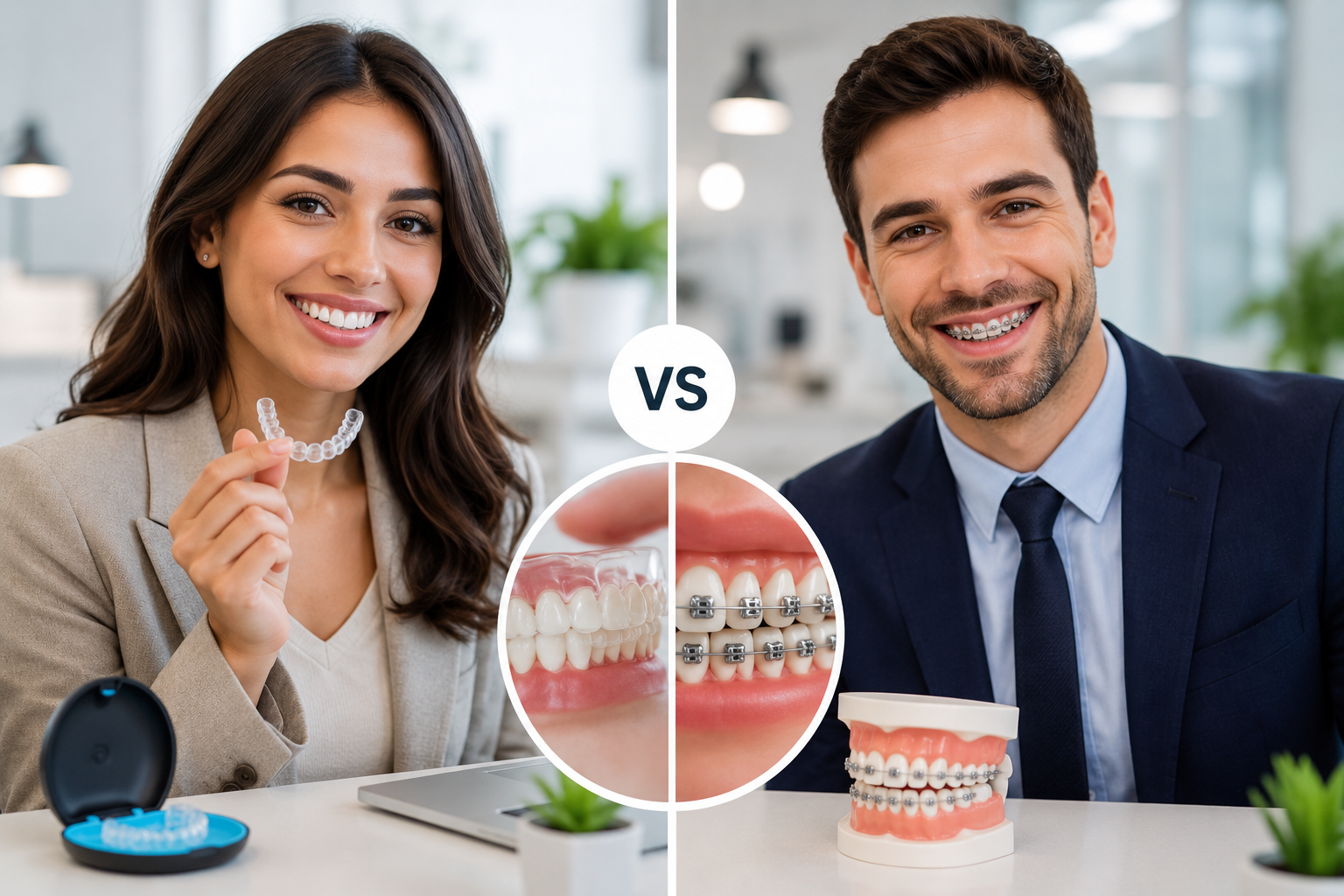
Invisalign vs Braces in Santa Rosa CA for Working Professionals: Which Is Right for You?

Considering orthodontic treatment as a working adult in Santa Rosa? The good news is that you have better options than ever before — but choosing between Invisalign and traditional braces isn’t always straightforward. For professionals concerned about appearance, comfort, and treatment schedules, here’s what actually matters.

The Core Difference: Visibility

Invisalign uses a series of clear, removable plastic aligners that are nearly invisible when worn. Traditional braces use metal brackets and wires bonded to teeth. For professionals who regularly give presentations, meet clients, or appear on camera, this difference matters significantly.

A 2022 study published in the Journal of Orthodontics found that clear aligner patients reported significantly higher satisfaction with their appearance during treatment compared to fixed appliance patients.

Comfort During the Workday

Both options cause some initial discomfort as teeth shift, but for different reasons. Metal braces can cause irritation to the inside of the lips and cheeks — a real problem if you’re speaking frequently during the day. Invisalign aligners are smooth plastic with no sharp edges, though new aligner trays cause pressure for the first 1–2 days after switching.

Treatment for Working Professionals: Practical Considerations

  • Appointments: Braces require monthly check-ups. Invisalign typically requires visits every 6–8 weeks — fewer interruptions to your schedule.
  • Eating: With braces, many foods are off-limits (popcorn, hard candy, crusty bread). Invisalign aligners are removed for eating — no restrictions.
  • Speaking: Some Invisalign patients notice a slight lisp for 1–2 weeks when starting. Braces rarely affect speech.
  • Oral hygiene: Invisalign aligners are removed for brushing and flossing — much easier. Braces require extra effort around brackets.

Which Straightens Teeth Faster?

Treatment time depends on case complexity, not just the appliance type. For mild to moderate alignment issues, Invisalign often takes 6–18 months. Traditional braces typically run 18–24 months. For complex cases — severe crowding, significant bite issues — braces may still be the more effective choice.

At Buzza Dental Group, we’ll evaluate your specific alignment needs and recommend the most efficient path to a straight smile.

Cost Comparison in Santa Rosa

Invisalign in Santa Rosa typically costs $3,000–$7,000, while traditional braces run $2,500–$6,000. The gap has narrowed considerably in recent years. Both options may be partially covered by dental insurance if the plan includes orthodontic benefits.

See full pricing details on our Invisalign page.

The Compliance Factor

Invisalign requires discipline. Aligners must be worn 20–22 hours per day to be effective. Removing them frequently — for coffee, snacks, or convenience — extends treatment time. For busy professionals who might be tempted to leave aligners out during long meetings or client dinners, this is worth considering honestly.

Braces, being fixed, work constantly without requiring any patient compliance.

Frequently Asked Questions

Can Invisalign fix an overbite or underbite?

Yes, modern Invisalign can address many bite issues that previously required braces. Complex bite corrections may still be better suited to traditional braces, which your dentist will evaluate.

Does Invisalign work for severe crowding?

Invisalign has significantly improved for complex cases, but very severe crowding or skeletal bite issues may still require braces or a combination approach.

Is Invisalign covered by dental insurance?

Many plans with orthodontic benefits cover Invisalign the same as braces, up to the plan maximum (typically $1,000–$2,500). Check your specific policy.

How often do I need to switch Invisalign trays?

Typically every 1–2 weeks. Your dentist will provide a series of trays at each appointment and track your progress.

What happens if I lose or break an Invisalign tray?

Contact your dentist immediately. You’ll usually move to the next tray in the series or get a replacement — minimal disruption to treatment.

Can adults over 40 get Invisalign?

Absolutely. Age is not a limiting factor for Invisalign. Adult orthodontics is one of the fastest-growing areas of dentistry.

Start Your Smile Journey in Santa Rosa

For most working professionals in Santa Rosa, Invisalign offers the best combination of effectiveness, discretion, and convenience. Schedule a consultation at Buzza Dental Group by calling 707-675-3434 — we’ll create a customized treatment plan that fits your lifestyle and timeline.

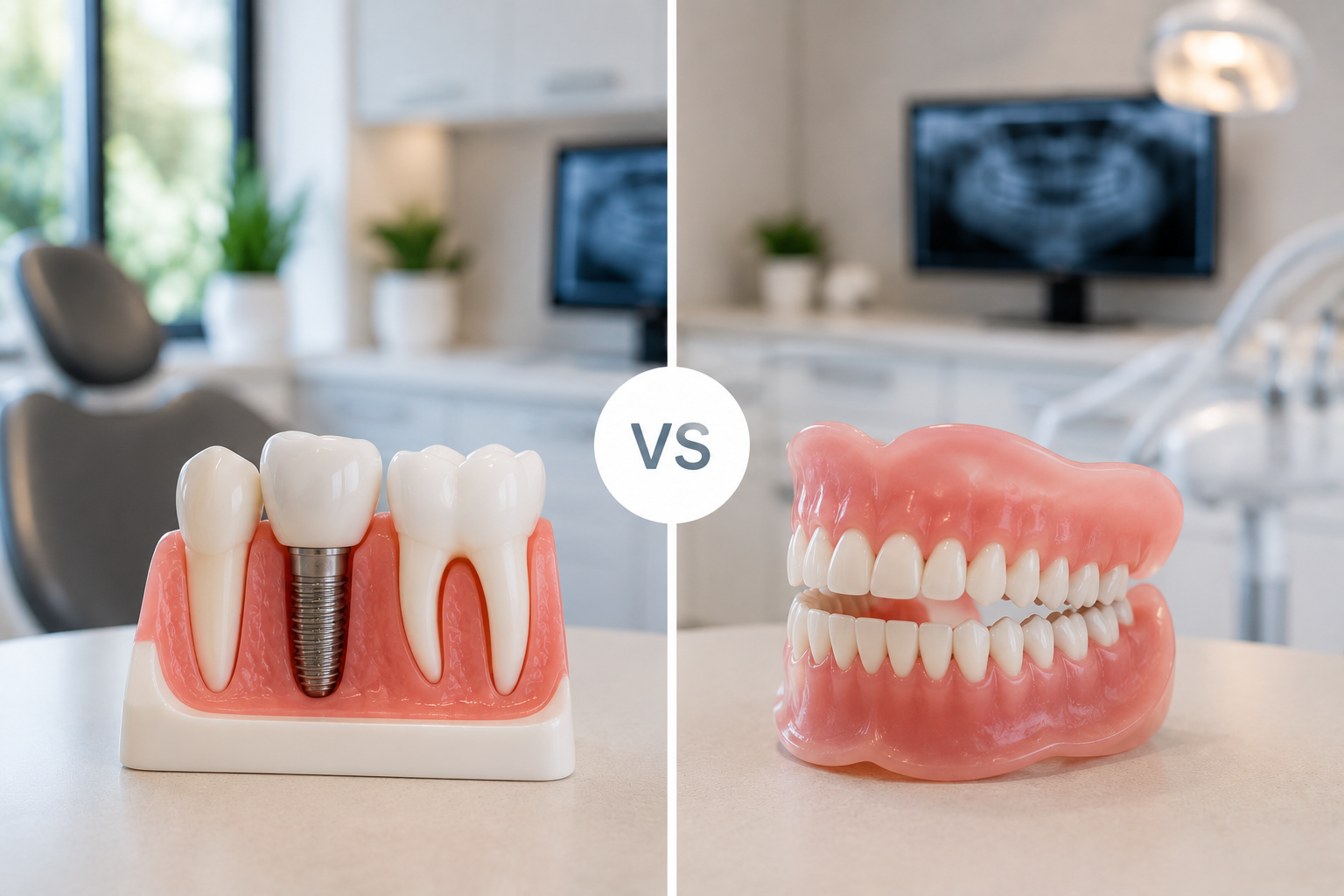
Dental Implants vs Dentures in Santa Rosa CA: Which Is the Better Long-Term Choice?

If you’re missing multiple teeth — or facing full tooth loss — two options will likely come up in your research: dental implants and dentures. Both can restore your smile, but they perform very differently over time. Here’s an honest comparison to help Santa Rosa patients make an informed decision.

How Dental Implants Work

Dental implants are titanium posts surgically placed into the jawbone, acting as artificial tooth roots. Once healed, they support crowns, bridges, or implant-supported dentures. They look, feel, and function like natural teeth — and according to the American Academy of Implant Dentistry, implants have a 95%+ long-term success rate.

How Dentures Work

Dentures are removable prosthetics that sit on top of the gums. Full dentures replace all teeth; partial dentures fill gaps between remaining natural teeth. They’re held in place by suction, adhesive, or clasps — not anchored to the jaw.

Long-Term Results: What Happens After 5, 10, and 20 Years?

  • 5 years: Implants remain stable. Dentures may need relining as gum tissue shifts.
  • 10 years: Implants still functioning normally. Bone loss under dentures becomes noticeable, changing facial structure.
  • 20 years: Implants, with proper care, still functional. Most dentures have been replaced 1–2 times. Bone loss can significantly alter jaw shape.

The Bone Loss Problem with Dentures

This is the critical long-term factor most people don’t know about. When you lose a tooth, the jawbone underneath begins to resorb (shrink) because there’s no root stimulating it. Dentures rest on the gum surface and do nothing to prevent this. Over time, this causes the denture to fit poorly, the face to appear sunken, and the need for periodic replacement.

Implants preserve bone by stimulating the jaw just like natural tooth roots, preventing the bone loss that accelerates facial aging.

Comfort and Daily Function

Implants win on comfort. They don’t slip, click, or require adhesive. You can eat anything — including corn on the cob, apples, and steak — without worry. Dentures restrict diet, can cause sore spots on gums, and some patients report embarrassment when they shift during conversation.

At Buzza Dental Group in Santa Rosa, many of our implant patients say it’s the single best dental decision they’ve ever made.

Cost Comparison Over Time

Implants have a higher upfront cost ($1,500–$4,000 per tooth) but lower lifetime cost. Dentures cost $1,000–$3,000 initially but require relining ($300–$500 every few years) and full replacement every 7–15 years. When calculated over 20 years, the costs often converge — while implants deliver a far superior quality of life.

Our team can walk you through financing options at our dental implants page.

Who Is a Better Candidate for Each Option?

Implants require sufficient bone density and healthy gums. Patients who smoke, have uncontrolled diabetes, or have significant bone loss may need additional treatment first. Dentures are accessible to almost anyone — making them the faster option for patients who need immediate tooth replacement or who cannot undergo surgery.

Frequently Asked Questions

Can I switch from dentures to implants later?

Yes, though bone grafting may be needed if significant bone loss has occurred. Many patients successfully transition from dentures to implant-supported alternatives.

Are implant-supported dentures an option?

Yes — implant-supported dentures combine both: implant posts anchor a full denture, providing much greater stability than traditional dentures while costing less than individual implants for every tooth.

How long does the implant process take?

Typically 3–6 months for a single implant. The titanium post must fuse to the jawbone before the crown is placed.

Are dentures painful to wear?

New dentures often cause soreness for 2–4 weeks as gums adjust. Long-term, poorly fitting dentures can cause chronic irritation.

Which option is better for someone over 70?

Age alone isn’t a disqualifying factor for implants. Overall health, bone density, and medication history matter more. Many patients in their 70s and 80s successfully receive implants.

Can dentures affect speech?

Yes, especially new or poorly fitting dentures. Implants do not affect speech once the healing period is complete.

Talk to a Santa Rosa Implant Dentist Today

The best choice between implants and dentures depends on your specific dental health, lifestyle, and long-term goals. Call Buzza Dental Group at 707-675-3434 to schedule a consultation and get expert guidance tailored to your situation.

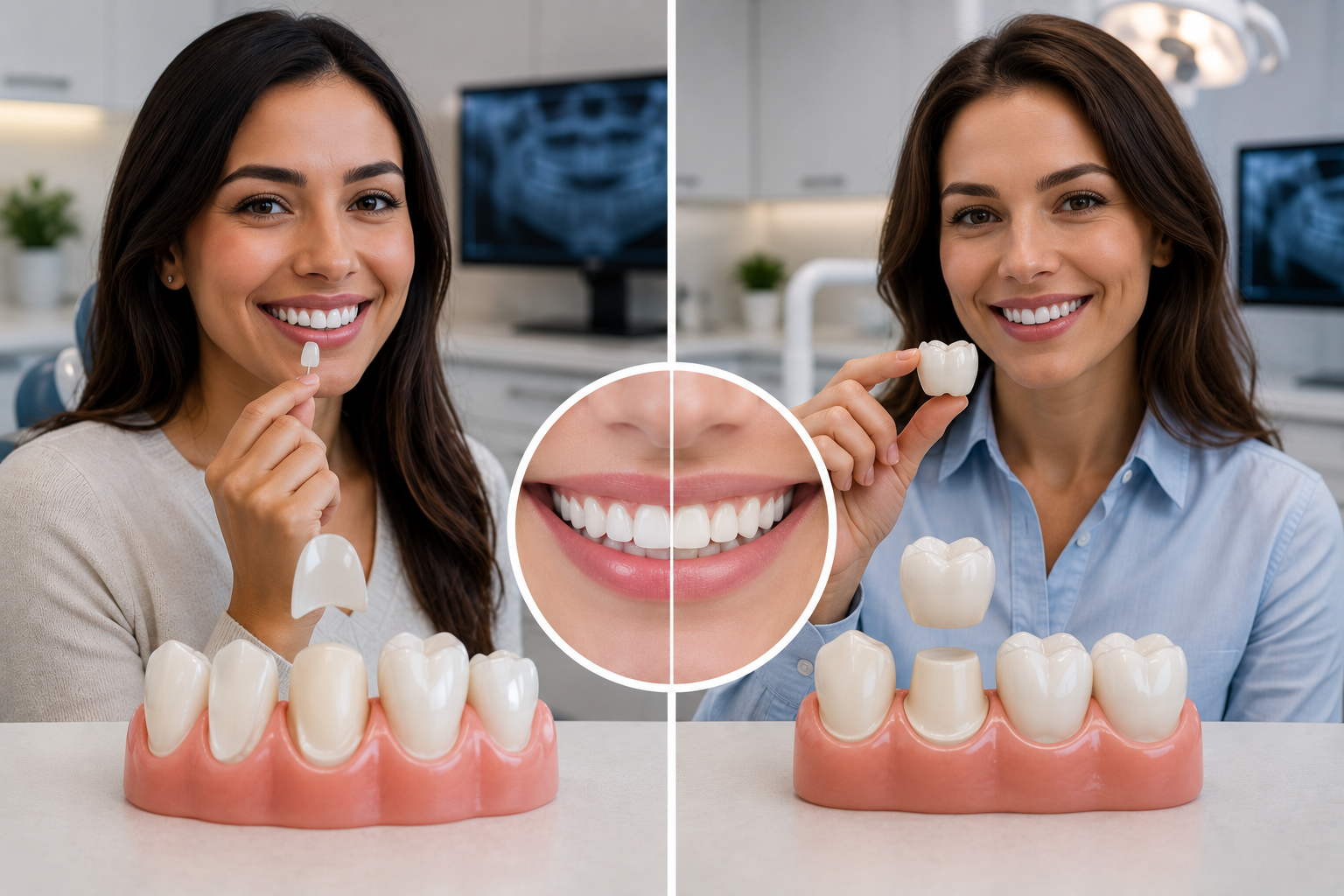
Veneers vs Crowns in Santa Rosa CA: Which Is the Better Option for Your Smile?

If your dentist has mentioned both veneers and crowns as solutions for a damaged or discolored tooth, you might be wondering which one is actually right for you. They look similar from the outside, but they serve very different purposes — and choosing the wrong one can cost you time and money.

What Are Dental Veneers?

Veneers are thin shells of porcelain or composite resin bonded to the front surface of a tooth. They’re used primarily for cosmetic improvements: staining, minor chips, slight gaps, or uneven tooth shape. The procedure removes a small amount of enamel — usually less than 1mm — to create a natural-looking result.

Porcelain veneers in Santa Rosa typically cost $900–$2,500 per tooth. Composite veneers are cheaper ($250–$1,500) but less durable and more prone to staining over time.

What Are Dental Crowns?

A crown (also called a cap) covers the entire tooth down to the gumline. Crowns are used when a tooth is significantly damaged, decayed, cracked, or has had a root canal. They restore both function and appearance. Crowns in Santa Rosa range from $1,000–$2,000 per tooth, depending on material.

Key Differences at a Glance

  • Coverage: Veneer = front surface only | Crown = entire tooth
  • Purpose: Veneer = cosmetic | Crown = structural + cosmetic
  • Enamel removed: Veneer = minimal | Crown = significant
  • Lifespan: Veneer = 10–15 years | Crown = 15–25 years
  • Strength: Crown is stronger for back teeth under heavy chewing

When Should You Choose a Veneer?

Veneers are the right choice when your tooth is structurally sound but cosmetically imperfect. Ideal candidates have teeth that are stained beyond whitening, mildly chipped, slightly misshapen, or have small gaps. The tooth should have enough enamel remaining for the veneer to bond to properly.

At Buzza Dental Group, we use high-quality porcelain veneers that match your natural tooth color and resist staining for years.

When Should You Choose a Crown?

Crowns are necessary when a tooth has significant structural damage: large cavities, cracks, fractures, or post-root canal weakness. A crown is also required to top a dental implant. Attempting to place a veneer on a structurally compromised tooth won’t provide the strength needed for long-term function.

Learn more about restoration options on our restorative dentistry page.

Can You Have Both Veneers and Crowns?

Yes — many patients get a combination. For a smile makeover, front teeth visible when smiling often get veneers, while heavily damaged back teeth or teeth that have had root canals get crowns. Your dentist will evaluate each tooth individually to recommend the best approach.

Frequently Asked Questions

Which is more expensive — veneers or crowns?

Per tooth, costs are similar, but veneers cover only the front while crowns cover the whole tooth. For cosmetic-only improvements, veneers often provide more value per dollar.

Do veneers or crowns look more natural?

Both can look completely natural when done by an experienced dentist. Modern porcelain closely mimics the translucency and shade of natural enamel.

Are veneers reversible?

No — because enamel is permanently removed to place a veneer, the process is irreversible. You’ll always need a veneer or crown on that tooth afterward.

Can a veneer be placed over a crown?

Generally no. If a crown already exists, it’s replaced with a new crown if the appearance needs improvement.

How do I know which one I need?

An examination and X-rays will tell your dentist whether the tooth is structurally sound enough for a veneer or needs the full coverage of a crown.

How long does each procedure take?

Both typically require 2 appointments: one to prepare the tooth and take impressions, and one to bond the final restoration. Each visit is usually 1–2 hours.

Schedule a Cosmetic Consultation in Santa Rosa

Choosing between veneers and crowns is a decision best made with an experienced cosmetic dentist who can examine your teeth and understand your goals. Call Buzza Dental Group at 707-675-3434 or visit us at 2448 Guerneville Rd, Santa Rosa to schedule your consultation.

Teeth Whitening Cost in Santa Rosa Before Your Wedding: What to Expect

Planning a wedding in Santa Rosa and want a smile that photographs beautifully? You’re not alone. Professional teeth whitening before a wedding is one of the most requested cosmetic dental treatments in Sonoma County. According to the American Academy of Cosmetic Dentistry, nearly 99% of adults believe a smile is an important social asset.

What Does Professional Teeth Whitening Cost in Santa Rosa?

In Santa Rosa, professional in-office teeth whitening typically ranges from $300 to $800 depending on the treatment type and number of sessions needed. Custom take-home tray whitening kits from a dentist run about $200 to $400.

  • In-office laser whitening: $400–$800 per session, same-day results
  • Custom take-home trays: $200–$400, results over 2–4 weeks
  • Combination treatment: $500–$900, best overall results
  • Store-bought strips: $20–$60, limited effectiveness

How Far in Advance Should You Whiten Before Your Wedding?

Timing matters. Most dentists recommend starting professional whitening 4 to 6 weeks before your wedding date. This gives you time to complete treatment, let sensitivity settle, and do a final touch-up if needed the week before.

If you only have 1–2 weeks before the big day, in-office treatment is your best option since it delivers visible results in a single 60–90 minute session.

Is Professional Whitening Worth It Over Store-Bought Kits?

For a wedding — where you’ll be photographed in high resolution under bright lights — professional whitening is a different league. Dentist-strength whitening gels use 25–40% hydrogen peroxide, compared to 3–10% in over-the-counter products.

At Buzza Dental Group in Santa Rosa, professional whitening treatments are customized to your enamel type, delivering maximum brightness without the uneven results that cheaper kits often produce.

What Affects the Final Cost?

Several factors influence what you’ll pay: severity of staining, starting shade, treatment type, number of sessions needed, and whether you add sensitivity treatment. Deep stains from coffee, wine, or tobacco typically require more sessions.

Teeth Whitening and Sensitivity: What to Expect

Sensitivity is the most common side effect, and it’s usually temporary — most patients experience it for 24–48 hours after treatment. Your dentist can recommend a desensitizing toothpaste to use before and after sessions.

If you have crowns, veneers, or bonding, keep in mind that whitening gel does not change the color of dental restorations. Discuss this with your dentist before treatment.

Can You Combine Whitening with Other Pre-Wedding Treatments?

Many Santa Rosa brides and grooms combine whitening with a professional cleaning, dental bonding to fix minor chips, or even veneers for a complete transformation. If considering multiple treatments, book a consultation at least 3 months before your wedding.

Learn more about full cosmetic options on the cosmetic dentistry page at Buzza Dental Group.

Does Dental Insurance Cover Whitening?

In most cases, no. Cosmetic teeth whitening is considered elective and is not covered by standard dental insurance plans. However, in-office financing options like CareCredit make it more accessible.

Frequently Asked Questions

How long do whitening results last after a wedding?

Professional whitening results typically last 1 to 3 years depending on your diet and oral habits. Avoiding coffee, red wine, and tobacco extends results significantly.

Is teeth whitening safe before a wedding?

Yes, when done by a licensed dentist. Professional treatments are carefully calibrated to your enamel, minimizing the risk of sensitivity or damage.

How white can my teeth get with professional treatment?

Most patients achieve 4 to 8 shades brighter. Teeth with yellowish stains respond better than grayish staining from certain medications.

Can I whiten if I have sensitive teeth?

Yes. Your dentist can use lower-concentration gels, shorter treatment times, and desensitizing agents to make the process comfortable.

What’s the best whitening treatment for someone on a tight timeline?

In-office whitening is your best option if you have 1–2 weeks. Custom take-home trays give excellent results if you have 4–6 weeks.

Do I need a dental checkup before whitening?

Yes. A quick exam ensures you have no cavities or gum issues that could cause problems during whitening.

Book Your Pre-Wedding Whitening Consultation in Santa Rosa

Your wedding photos last a lifetime. Getting your smile professionally whitened at Buzza Dental Group means you walk down the aisle with confidence. Serving Santa Rosa, Rohnert Park, Windsor, and Sebastopol — call 707-675-3434 or visit our teeth whitening page to schedule your consultation today.

Top-Rated Dentists in Santa Rosa CA for Cosmetic and General Care 2026

Finding a dentist you actually trust is harder than it sounds. The options in Santa Rosa range from large chain practices with rotating staff to boutique offices where you see the same dentist every single visit. The right fit depends on what you need — but the practices that have earned genuine long-term reputations in Sonoma County are worth knowing about.

This guide covers the top-rated dentists in Santa Rosa CA for both cosmetic and general dental care in 2026. Whether you need a routine cleaning, a full smile makeover, an implant, or a dentist your whole family can rely on for years, these are the practices worth considering.

WHAT MAKES A DENTIST TRULY TOP-RATED?

A top-rated dentist is not simply one with a lot of Google reviews. The practices worth trusting show up consistently across multiple indicators:

– Verified reviews across Google, Yelp, and Healthgrades that describe specific positive experiences

– Years of practice in the local community — not a practice that opened recently

– A range of services that allows patients to get most of their care in one place

– Advanced training and credentials beyond general dental school

– A clearly stated approach to patient comfort, particularly for anxious patients

– Transparent communication about costs and treatment options before anything begins

– Recognition from professional or media organizations

With those benchmarks in mind, here are the top-rated dentists in Santa Rosa CA.

TOP-RATED DENTISTS IN SANTA ROSA CA

1. Buzza Dental Group – Dr. John Buzza, DDS

Dr. John Buzza is the most decorated and longest-established dentist in Santa Rosa. He has been voted Best Dentist in Sonoma County eight years in a row by local publications, was selected for ABC’s Extreme Makeover for complex cosmetic cases, and holds a KOIS Center credential for Distinguished Dental Excellence — one of the highest post-graduate recognitions in cosmetic and restorative dentistry.

With more than 40 years of practice in Santa Rosa, Dr. Buzza has built a patient base that spans multiple generations of Sonoma County families. That kind of loyalty is not built by advertising — it is built by consistent, honest care that delivers real outcomes.

His practice offers the full range of cosmetic and general dental services:

General and Preventive Care:

– Comprehensive exams and digital X-rays

– Professional cleanings (prophylaxis)

– Cavity detection and composite fillings

– Gum disease assessment and management with laser dentistry

– Emergency dental care

Cosmetic Dentistry:

– Porcelain veneers and smile makeovers

– Professional teeth whitening (in-office and take-home)

– Cosmetic bonding and tooth reshaping

– Invisalign clear aligner therapy

Restorative Dentistry:

– Dental crowns and bridges

– Dental implants including same-day implants and All-on-4

– Full-mouth restorations

Sedation Dentistry:

– Nitrous oxide (laughing gas)

– Oral conscious sedation

– IV sedation options for complex or anxiety-driven cases

What makes Buzza Dental Group stand apart — particularly for patients who have had negative dental experiences in the past — is the practice’s foundational commitment to comfort. Dr. Buzza built his reputation specifically on making dental care accessible to people who are afraid of the dentist. His team trains around that philosophy, and patient reviews consistently describe feeling welcomed, respected, and surprisingly at ease.

What patients are saying:

“I haven’t enjoyed going to the dentist this much ever. Dr. Buzza is very kind and knows his stuff. They’re bringing my smile back to how it used to be, which makes me very happy.”

“The staff at Santa Rosa Dental is top-notch, from the care coordinator to Dr. Buzza. If you need this kind of care, GO SEE THEM! They will take great care of you!”

2. Creative Dentistry of Santa Rosa

Creative Dentistry has built a strong local following for cosmetic work. Patients reviewing this practice point to personalized consultations and a boutique-style office environment. A good choice for patients whose primary need is cosmetic improvement.

3. Santa Rosa Implant Center

This practice has developed a focused reputation in the implant space. For patients with specific tooth-replacement needs who want to work with a practice that does implant work every day, this is a straightforward option.

4. SP Dental – Santa Rosa

SP Dental serves patients across both general and cosmetic needs. Reviewers note a patient-friendly atmosphere and clear communication. A practical option for patients looking for a neighborhood-style general practice.

5. Western Dental – Santa Rosa

Western Dental brings broad scheduling availability through its multi-location network. Best suited for patients who prioritize scheduling flexibility and want access to basic general and cosmetic services.

6. Bonin Dental

Bonin Dental is an established Santa Rosa practice offering both general and restorative services. Patients describe thorough treatment explanations and a patient-centered approach to care planning.

WHAT TO EXPECT FROM A GENERAL DENTAL VISIT IN SANTA ROSA

If you are overdue for a dental check-up, here is what a first appointment at a practice like Buzza Dental Group typically involves.

A comprehensive exam covers the health of each tooth, your gum tissue, your bite alignment, and a check for any signs of oral cancer. Digital X-rays are taken to identify any issues that are not visible to the naked eye.

A professional cleaning removes plaque and tartar buildup from surfaces that brushing and flossing cannot fully reach. Hardened tartar can only be removed with professional instruments.

Treatment planning happens after the exam, not before. At Buzza Dental Group, any recommended treatment is discussed in private, in plain language, with a full cost breakdown before you agree to anything. You are never pressured to start treatment on the spot.

If cosmetic goals are part of your visit, the consultation covers your aesthetic objectives alongside clinical needs, so you leave with a clear understanding of both what is necessary and what is possible.

HOW OFTEN SHOULD YOU SEE A DENTIST IN SANTA ROSA?

For most adults, twice a year is the standard recommendation. That said, patients with gum disease, a history of frequent cavities, or ongoing restorative work in progress may benefit from three or four visits per year.

The logic behind regular visits is straightforward: problems caught early are almost always cheaper and less invasive to treat than problems that develop undetected over months or years. A cavity caught at its first sign is a 20-minute filling. The same cavity left for 18 months may require a root canal, a crown, or eventually an implant.

Regular cleanings also matter for your overall health. According to the Centers for Disease Control and Prevention (CDC), periodontal (gum) disease affects nearly half of adults over 30 in the United States. Untreated gum disease has been linked to increased risk of heart disease, diabetes complications, and adverse pregnancy outcomes.

CHOOSING BETWEEN A GENERAL DENTIST AND A SPECIALIST

Most dental needs — cleanings, fillings, crowns, whitening, basic cosmetic work, and even many implant cases — can be handled by an experienced general dentist. The advantage of working with a practice like Buzza Dental Group is that Dr. Buzza has the training to handle the full scope of your care in one place. You do not need a separate specialist for whitening, another for implants, and another for Invisalign.

When specialist referrals are genuinely necessary — for example, in complex oral surgery cases or situations requiring an orthodontist for severe bite correction — a well-established general dentist will have those referral relationships and will coordinate your care throughout.

FREQUENTLY ASKED QUESTIONS: TOP-RATED DENTISTS IN SANTA ROSA CA

How do I find a dentist in Santa Rosa who accepts my insurance?

Call the practice directly and ask which insurance plans they accept. Buzza Dental Group works with most major PPO plans and will help you understand your benefits before treatment begins.

What is the difference between a cosmetic dentist and a general dentist?

General dentists maintain your oral health. Cosmetic dentists focus on the appearance of your smile. Many excellent general dentists, including Dr. Buzza, have extensive cosmetic training and handle both functions in their practice.

What if I have not been to a dentist in several years?

You will not be judged. Practices like Buzza Dental Group are specifically built for patients who feel embarrassed or anxious about returning to dental care after a long gap. Dr. Buzza’s team approaches these appointments with patience, not criticism. The first step is simply a thorough exam to understand where things stand.

Do top-rated dentists in Santa Rosa offer payment plans?

Yes. Buzza Dental Group offers financing through CareCredit and LendingClub, making it possible to spread treatment costs over time with manageable monthly payments.

How do I book an appointment at Buzza Dental Group?

Call 707-675-3434 or visit santarosadentist.com. New patient appointments are available, and the team will walk you through what to expect before your first visit.

Whether you need a routine cleaning, a smile transformation, an implant, or a dentist who can handle every aspect of your family’s dental care, the right practice in Santa Rosa is within reach. Buzza Dental Group has the experience, the credentials, and the patient-first culture that has made it the most trusted dental practice in Sonoma County for over 40 years.

Call 707-675-3434 or visit santarosadentist.com to schedule your appointment.

Dr. Buzza, DDS

BUZZA DENTAL GROUP

Enriching Lives, Exceeding Expectations

2448 Guerneville Rd. Suite 1200, Santa Rosa, CA 95403
Phone: 707-573-0600 • Fax: 707-324-1234
info@santarosadentist.com